[Guides & How-tos]
[Guides & How-tos]
Reading Your First Amorfs Document
Reading Your First Amorfs Document
Reading Your First Amorfs Document
13 Dec 2025

What is the Amorfs Format?
Amorfs is a human-readable data format that sits somewhere between YAML and RDF - designed for both humans to edit and machines to process.
Think of it as the "source code" of your data that anyone can read and understand.
The Two Magic Symbols
Amorfs uses just two relationship types to represent any data:
Symbol | Meaning | Example Use |
|---|---|---|
- | "has a" (attribution) | A person - phone number |
[ ] | "which is" (identification) | phone [0401062720] |
That's it. With just these two symbols, you can represent incredibly complex information.
Reading Your First Example
Let's decode this simple Amorfs snippet:
person [Tim
- phone [0421042723]
- email [tim@example.com]
]
How to read it:
person [Tim → "A person which is 'Tim'"
- phone [0421042723] → "has a phone which is '0421042723'"
- email [tim@example.com] → "has an email which is 'tim@example.com'"
In plain English: "A person named Tim has a phone number 042104273 and has an email tim@example.com"
Multiple Expressions: The Power of |
The vertical bar | means "OR" - different ways to express the same concept:
state [NSW | New South Wales]
This says: "A state which is 'NSW' OR 'New South Wales'"
Both expressions point to the same underlying concept. The system knows they're the same thing.
Multi-language example:
country [Australia | Australie | オーストラリア]
Same concept, three languages. The beauty is that the concept graph stays the same regardless of language.
Nesting: Concepts Within Concepts
Square brackets can nest to any depth:
payment_card [
- number [4532 1234 5678 9010]
- expiry [12/25]
- type [Visa]
- billing_address [
- street [123 Main St]
- city [Sydney]
- postcode [2000]
]
]
Each level of nesting represents a concept that "has a" relationship with sub-concepts.
Practical Reading Exercise
Let's read a real-world example:
university [Oxford
- fellow [C. S. Lewis
- birth_date [19 Nov 1898]
- college [Magdalen College
- address [
- city [Oxford]
- postcode [OX1 4AU]
- country [UK]
]
]
]
]
Breaking it down:
Oxford university has a fellow which is C. S. Lewis
C. S. Lewis has a birth date which is 19 Nov 1898
C. S. Lewis has a college which is Magdalen College
Magdalen College has an address
That address has a city which is Oxford
That address has a postcode which is OX1 4AU
That address has a country which is UK
The Beautiful Part: Self-Organization
When you provide alternative expressions later, Amorfs automatically merges concepts:
Before:
state [NSW]
state [New South Wales]
(Two separate concepts for state)
After you provide both expressions:
state [NSW | New South Wales]
(One unified concept)
All previous references automatically update. The system self-organizes based on the semantics you provide.
Key Takeaways
- means "has a" relationship
[ ] contains what something "is"
| separates multiple expressions of the same concept
Nesting captures structure and context
The format is both human-readable and machine-parseable
Try It Yourself
Here's a simple structure to practice reading:
book [The Lord of the Rings
- author [J.R.R. Tolkien | Tolkien]
- published [1954]
- genre [Fantasy]
]
Can you read this out loud as relationships?
Next up: "Writing Your First Amorfs Structure" →
Remember: You're not learning a programming language. You're learning a new way to think about data.
What is the Amorfs Format?
Amorfs is a human-readable data format that sits somewhere between YAML and RDF - designed for both humans to edit and machines to process.
Think of it as the "source code" of your data that anyone can read and understand.
The Two Magic Symbols
Amorfs uses just two relationship types to represent any data:
Symbol | Meaning | Example Use |
|---|---|---|
- | "has a" (attribution) | A person - phone number |
[ ] | "which is" (identification) | phone [0401062720] |
That's it. With just these two symbols, you can represent incredibly complex information.
Reading Your First Example
Let's decode this simple Amorfs snippet:
person [Tim
- phone [0421042723]
- email [tim@example.com]
]
How to read it:
person [Tim → "A person which is 'Tim'"
- phone [0421042723] → "has a phone which is '0421042723'"
- email [tim@example.com] → "has an email which is 'tim@example.com'"
In plain English: "A person named Tim has a phone number 042104273 and has an email tim@example.com"
Multiple Expressions: The Power of |
The vertical bar | means "OR" - different ways to express the same concept:
state [NSW | New South Wales]
This says: "A state which is 'NSW' OR 'New South Wales'"
Both expressions point to the same underlying concept. The system knows they're the same thing.
Multi-language example:
country [Australia | Australie | オーストラリア]
Same concept, three languages. The beauty is that the concept graph stays the same regardless of language.
Nesting: Concepts Within Concepts
Square brackets can nest to any depth:
payment_card [
- number [4532 1234 5678 9010]
- expiry [12/25]
- type [Visa]
- billing_address [
- street [123 Main St]
- city [Sydney]
- postcode [2000]
]
]
Each level of nesting represents a concept that "has a" relationship with sub-concepts.
Practical Reading Exercise
Let's read a real-world example:
university [Oxford
- fellow [C. S. Lewis
- birth_date [19 Nov 1898]
- college [Magdalen College
- address [
- city [Oxford]
- postcode [OX1 4AU]
- country [UK]
]
]
]
]
Breaking it down:
Oxford university has a fellow which is C. S. Lewis
C. S. Lewis has a birth date which is 19 Nov 1898
C. S. Lewis has a college which is Magdalen College
Magdalen College has an address
That address has a city which is Oxford
That address has a postcode which is OX1 4AU
That address has a country which is UK
The Beautiful Part: Self-Organization
When you provide alternative expressions later, Amorfs automatically merges concepts:
Before:
state [NSW]
state [New South Wales]
(Two separate concepts for state)
After you provide both expressions:
state [NSW | New South Wales]
(One unified concept)
All previous references automatically update. The system self-organizes based on the semantics you provide.
Key Takeaways
- means "has a" relationship
[ ] contains what something "is"
| separates multiple expressions of the same concept
Nesting captures structure and context
The format is both human-readable and machine-parseable
Try It Yourself
Here's a simple structure to practice reading:
book [The Lord of the Rings
- author [J.R.R. Tolkien | Tolkien]
- published [1954]
- genre [Fantasy]
]
Can you read this out loud as relationships?
Next up: "Writing Your First Amorfs Structure" →
Remember: You're not learning a programming language. You're learning a new way to think about data.
Share to
Latest Post
View All
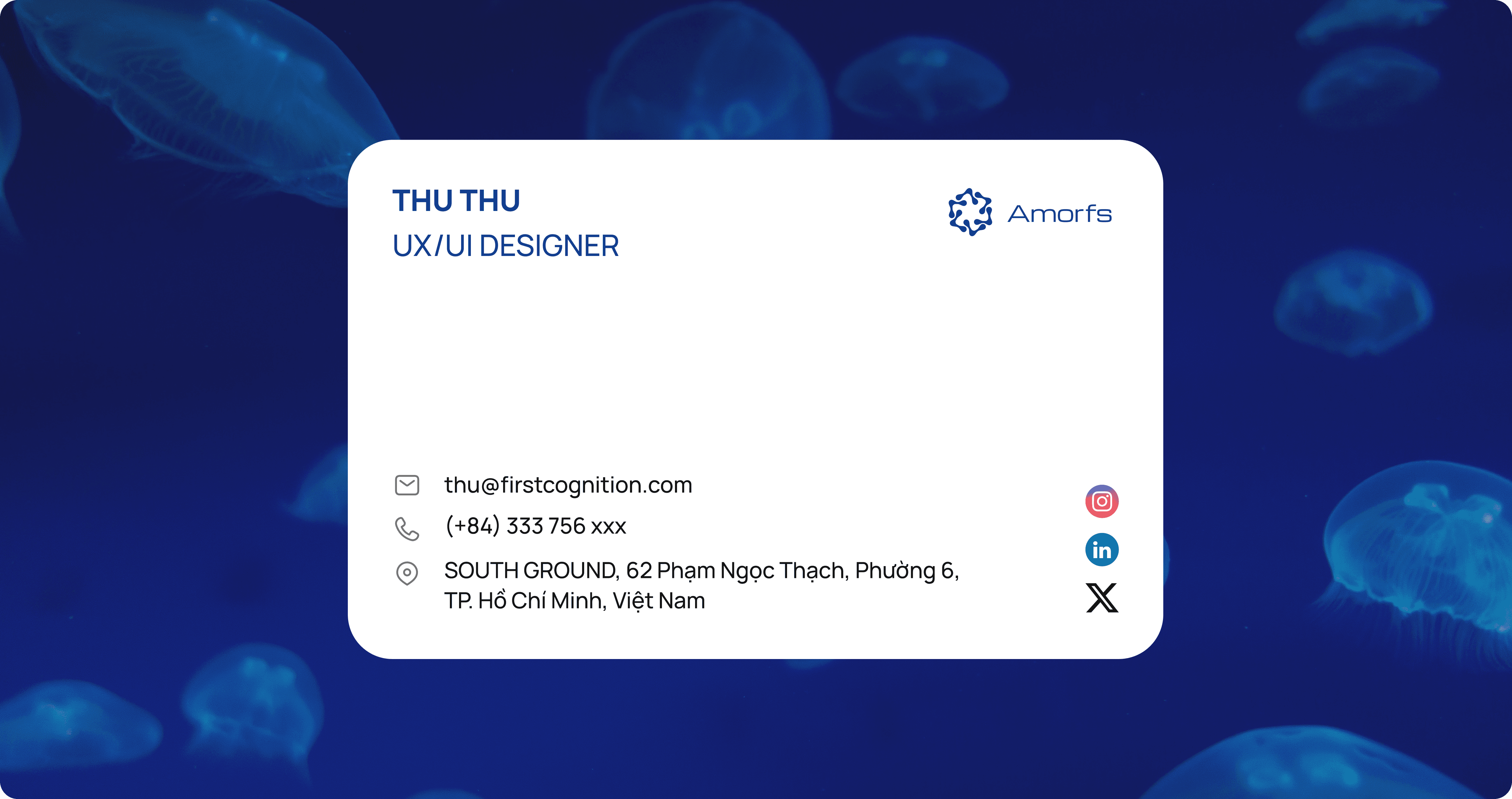
[User Stories]
Designer's Experience - 👩💻 How I turned a Figma Design into something I actually use
14 Jan 2026
[User Stories]
Designer's Experience - 👩💻 How I turned a Figma Design into something I actually use
14 Jan 2026
[User Stories]
Designer's Experience - 👩💻 How I turned a Figma Design into something I actually use
14 Jan 2026
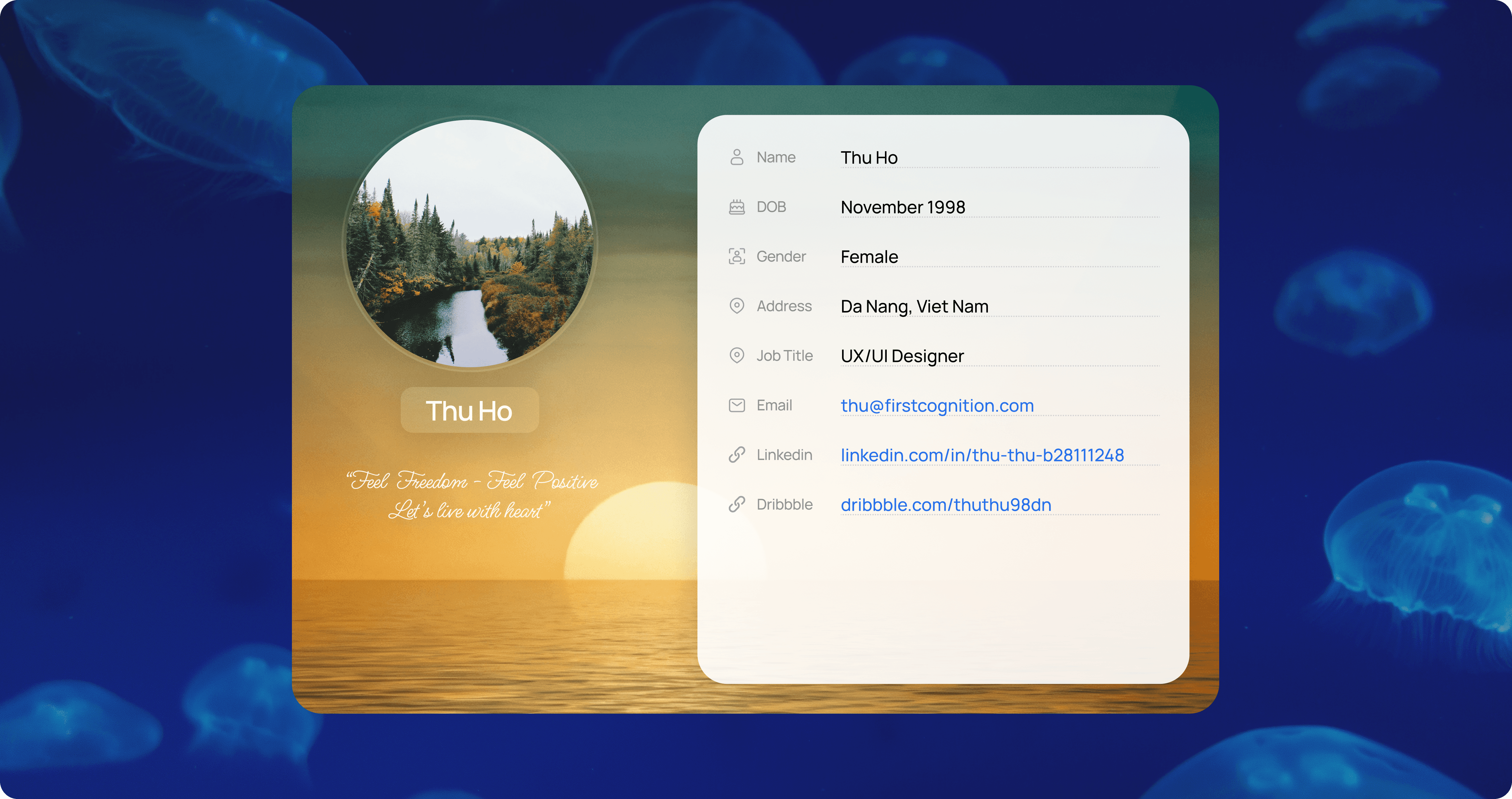
[User Stories]
Designer's Experience - 👩💻 From Figma to a profile that’s ready to live
14 Jan 2026
[User Stories]
Designer's Experience - 👩💻 From Figma to a profile that’s ready to live
14 Jan 2026
[User Stories]
Designer's Experience - 👩💻 From Figma to a profile that’s ready to live
14 Jan 2026
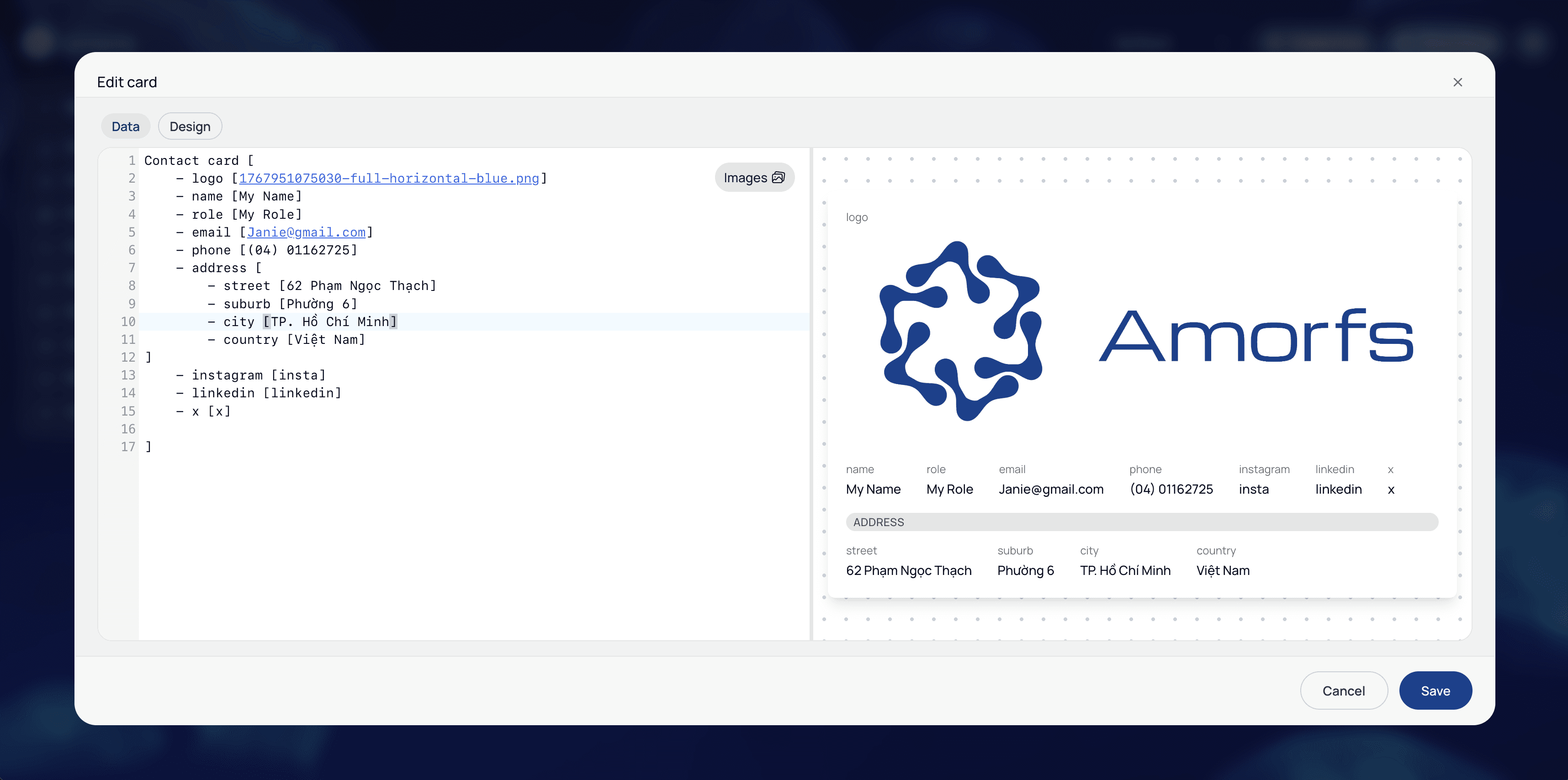
[Guides & How-tos]
How to Create a New Card in Amorfs Studio
8 Jan 2026
[Guides & How-tos]
How to Create a New Card in Amorfs Studio
8 Jan 2026
[Guides & How-tos]
How to Create a New Card in Amorfs Studio
8 Jan 2026


PRODUCTS
Amorfs Extension
SUPPORT
Don’t want to miss anything?
Get weekly updates on the newest posts, events and tips right in your mailbox.
" height="47.8243px" id="Fi98aqQOS" width="48.001px"/><path d="M 20.148 22.45 L 21.494 15.115 L 13.655 15.115 L 13.655 12.521 C 13.655 8.646 15.176 7.155 19.111 7.155 C 20.333 7.155 21.317 7.185 21.883 7.244 L 21.883 0.596 C 20.81 0.298 18.186 0 16.666 0 C 8.646 0 4.949 3.786 4.949 11.955 L 4.949 15.115 L 0 15.115 L 0 22.45 L 4.949 22.45 L 4.949 38.409 C 6.805 38.869 8.747 39.115 10.746 39.115 C 11.73 39.115 12.701 39.055 13.654 38.94 L 13.654 22.45 L 20.147 22.45 Z" fill="rgb(255, 255, 255)" height="39.11523px" id="o10gvlFLv" transform="translate(13.253 8.885)" width="21.883200000000002px"/></g></svg>)
PRODUCTS
Amorfs Extension
SUPPORT
Don’t want to miss anything?
Get weekly updates on the newest posts, events and tips right in your mailbox.
PRODUCTS
Amorfs Extension
SUPPORT
Don’t want to miss anything?
Get weekly updates on the newest posts, events and tips right in your mailbox.
PRODUCTS
Amorfs Extension
SUPPORT
Don’t want to miss anything?
Get weekly updates on the newest posts, events and tips right in your mailbox.