[Guides & How-tos]
[Guides & How-tos]
Building Relationships: Associations in Amorfs
Building Relationships: Associations in Amorfs
Building Relationships: Associations in Amorfs
13 Dec 2025
Beyond Simple Data
Most data formats can store facts: names, dates, numbers. But reality is about relationships.
Who works WHERE?
What happened WHEN?
Which product came FROM which supplier?
Amorfs makes relationships first-class citizens of your data.
What is an Association?
An association is a connection between concepts. In Amorfs, every association follows the same pattern our brains use:
Subject - Verb - Object
Just like in natural language:
"Sarah works for Acme Corp"
"The package was shipped from Warehouse A"
"This invoice is valid until December 31st"
The Two Basic Associations
While the Amorfs data model supports any relationship verb, the data format can represent traditional data using just two:
1. "has a" (the - symbol)
Shows a connection or attribute:
person [Sarah
- employer [Acme Corp]
- phone [555-1234]
- office [Building 5]
]
Read as: "Sarah has an employer which is Acme Corp, has a phone which is 555-1234..."
2. "which is" (the [ ] brackets)
Shows what something actually is:
employee id [E-12345]
status [active]
Read as: "An employee id which is E-12345, a status which is active"
Recursive Power: The Game-Changer
Here's where Amorfs becomes revolutionary. Every association is itself a concept, which means associations can reference other associations.
Simple Example: Supply Chain
shipment [
- origin [Warehouse A]
- destination [Store B]
- previous_shipment [
- origin [Factory C]
- destination [Warehouse A]
- previous_shipment [
- origin [Supplier D]
- destination [Factory C]
]
]
]
Each shipment carries the context of the previous shipment. The chain creates a complete provenance trail.
Traditional Approach (What We Lost):
shipment_1: origin=Supplier_D, destination=Factory_C
shipment_2: origin=Factory_C, destination=Warehouse_A
shipment_3: origin=Warehouse_A, destination=Store_B
Problem: The connections exist in your head, not in the data. To reconstruct the chain, you need separate logic.
Amorfs Approach (What We Gain):
The entire context flows forward through the data. Each association carries the full history.
Real-World Example: Document Revision History
document [Proposal_v3.docx
- author [Sarah]
- modified [2024-12-13]
- previous version [Proposal_v2.docx
- author [John]
- modified [2024-12-10]
- previous version [Proposal_v1.docx
- author [Sarah]
- modified [2024-12-05]
]
]
]
The current document contains the complete history of its evolution.
Associations as First-Class Concepts
Because associations ARE concepts, they can:
1. Have their own expressions
employer [Mining Corp
- employee [Sarah]
- start_date [2020-01-15]
]
This employer Mining Corp relationship is a concept that can be referenced elsewhere.
2. Have metadata
transaction [
- amount [127.50]
- vendor [Acme Corp]
] {~0.95 source:@statement}
The transaction itself has properties: confidence level, source.
3. Be subjects or objects of other associations
country [Australia
- state [NSW
- city [Sydney
- postcode [2000]
]
]
]
Each association inherits all the preceding associations, so the postcode 2000 concept carries a state, city and county.
Intrinsic vs. Contextual Associations
Amorfs distinguishes between two types of relationships:
Intrinsic (+ symbol) - "Always Has"
Properties that are inherent and unchanging:
person [Sarah Johnson
+ birth_date [1985-03-20]
+ nationality [Australian]
]
Birth date and nationality are intrinsic - they define who Sarah is fundamentally.
Contextual (- symbol) - "May Have"
Properties that depend on circumstances:
person [Sarah Johnson
- employer [Acme Corp]
- residence [Sydney]
- phone [555-1234]
]
Employer, residence, and phone are contextual - they can change over time.
Why This Matters
When merging data from multiple sources:
Intrinsic associations help identify if two concepts are the same person. They associate the expression concept.
Contextual associations might differ and need conflict resolution. They associate the parent association, extending the context chain.
Nested Structures: Infinite Detail
You can nest as deeply as needed:
organization [Acme Corp
- department [Engineering
- team [Backend
- developer [Sarah
- project [API Redesign
- task [Database Migration
- subtask [Schema Update
- status [In Progress]
]
]
]
]
]
]
]
Each level adds more context and specificity.
The Beauty: Self-Contained Context
Unlike traditional databases where you need multiple tables and JOIN operations:
Traditional:
Table: Employees
Table: Departments
Table: Projects
Table: Tasks
Needs queries to connect them
Amorfs:
employee [Sarah
- department [Engineering
- manager [Bob]
- budget [500000]
]
- project [API Redesign
- deadline [2025-03-01]
- status [Active]
]
]
All context travels together. Cut and paste this fragment anywhere, and it's still meaningful.
Practical Example: Invoice with Full Context
invoice [
- number [INV-2024-001]
- date [2024-12-13]
- amount [1250.00
- currency [USD]
]
- vendor [Tech Supplies Inc.
- address [
- street [123 Business Ave]
- city [San Francisco]
]
- contact [
- email [orders@techsupplies.com]
- phone [+1-555-0199]
]
]
- items [
- item [Laptop
- quantity [2]
- unit_price [500.00]
]
- item [Mouse
- quantity [5]
- unit_price [50.00]
]
]
- payment_terms [Net 30]
]
Everything an AI or accounting system needs to understand this invoice travels with it.
Key Takeaways
Associations follow Subject-Verb-Object patterns
Associations are concepts - they can be referenced and nested
Recursion enables unlimited context - history and provenance flow forward
Intrinsic (+) vs. Contextual (-) helps with data quality and merging
Self-contained fragments maintain meaning when copied anywhere
Try This
Think about your employment history. How would you represent it in Amorfs showing:
Current employer
Previous employers
Dates and roles
Department structures
Remember: Each job is contextual (-), but the sequence is preserved through nesting.
Next: "Writing Your First Amorfs Structure" →
Relationships are what make data meaningful. Amorfs makes relationships explicit.
Beyond Simple Data
Most data formats can store facts: names, dates, numbers. But reality is about relationships.
Who works WHERE?
What happened WHEN?
Which product came FROM which supplier?
Amorfs makes relationships first-class citizens of your data.
What is an Association?
An association is a connection between concepts. In Amorfs, every association follows the same pattern our brains use:
Subject - Verb - Object
Just like in natural language:
"Sarah works for Acme Corp"
"The package was shipped from Warehouse A"
"This invoice is valid until December 31st"
The Two Basic Associations
While the Amorfs data model supports any relationship verb, the data format can represent traditional data using just two:
1. "has a" (the - symbol)
Shows a connection or attribute:
person [Sarah
- employer [Acme Corp]
- phone [555-1234]
- office [Building 5]
]
Read as: "Sarah has an employer which is Acme Corp, has a phone which is 555-1234..."
2. "which is" (the [ ] brackets)
Shows what something actually is:
employee id [E-12345]
status [active]
Read as: "An employee id which is E-12345, a status which is active"
Recursive Power: The Game-Changer
Here's where Amorfs becomes revolutionary. Every association is itself a concept, which means associations can reference other associations.
Simple Example: Supply Chain
shipment [
- origin [Warehouse A]
- destination [Store B]
- previous_shipment [
- origin [Factory C]
- destination [Warehouse A]
- previous_shipment [
- origin [Supplier D]
- destination [Factory C]
]
]
]
Each shipment carries the context of the previous shipment. The chain creates a complete provenance trail.
Traditional Approach (What We Lost):
shipment_1: origin=Supplier_D, destination=Factory_C
shipment_2: origin=Factory_C, destination=Warehouse_A
shipment_3: origin=Warehouse_A, destination=Store_B
Problem: The connections exist in your head, not in the data. To reconstruct the chain, you need separate logic.
Amorfs Approach (What We Gain):
The entire context flows forward through the data. Each association carries the full history.
Real-World Example: Document Revision History
document [Proposal_v3.docx
- author [Sarah]
- modified [2024-12-13]
- previous version [Proposal_v2.docx
- author [John]
- modified [2024-12-10]
- previous version [Proposal_v1.docx
- author [Sarah]
- modified [2024-12-05]
]
]
]
The current document contains the complete history of its evolution.
Associations as First-Class Concepts
Because associations ARE concepts, they can:
1. Have their own expressions
employer [Mining Corp
- employee [Sarah]
- start_date [2020-01-15]
]
This employer Mining Corp relationship is a concept that can be referenced elsewhere.
2. Have metadata
transaction [
- amount [127.50]
- vendor [Acme Corp]
] {~0.95 source:@statement}
The transaction itself has properties: confidence level, source.
3. Be subjects or objects of other associations
country [Australia
- state [NSW
- city [Sydney
- postcode [2000]
]
]
]
Each association inherits all the preceding associations, so the postcode 2000 concept carries a state, city and county.
Intrinsic vs. Contextual Associations
Amorfs distinguishes between two types of relationships:
Intrinsic (+ symbol) - "Always Has"
Properties that are inherent and unchanging:
person [Sarah Johnson
+ birth_date [1985-03-20]
+ nationality [Australian]
]
Birth date and nationality are intrinsic - they define who Sarah is fundamentally.
Contextual (- symbol) - "May Have"
Properties that depend on circumstances:
person [Sarah Johnson
- employer [Acme Corp]
- residence [Sydney]
- phone [555-1234]
]
Employer, residence, and phone are contextual - they can change over time.
Why This Matters
When merging data from multiple sources:
Intrinsic associations help identify if two concepts are the same person. They associate the expression concept.
Contextual associations might differ and need conflict resolution. They associate the parent association, extending the context chain.
Nested Structures: Infinite Detail
You can nest as deeply as needed:
organization [Acme Corp
- department [Engineering
- team [Backend
- developer [Sarah
- project [API Redesign
- task [Database Migration
- subtask [Schema Update
- status [In Progress]
]
]
]
]
]
]
]
Each level adds more context and specificity.
The Beauty: Self-Contained Context
Unlike traditional databases where you need multiple tables and JOIN operations:
Traditional:
Table: Employees
Table: Departments
Table: Projects
Table: Tasks
Needs queries to connect them
Amorfs:
employee [Sarah
- department [Engineering
- manager [Bob]
- budget [500000]
]
- project [API Redesign
- deadline [2025-03-01]
- status [Active]
]
]
All context travels together. Cut and paste this fragment anywhere, and it's still meaningful.
Practical Example: Invoice with Full Context
invoice [
- number [INV-2024-001]
- date [2024-12-13]
- amount [1250.00
- currency [USD]
]
- vendor [Tech Supplies Inc.
- address [
- street [123 Business Ave]
- city [San Francisco]
]
- contact [
- email [orders@techsupplies.com]
- phone [+1-555-0199]
]
]
- items [
- item [Laptop
- quantity [2]
- unit_price [500.00]
]
- item [Mouse
- quantity [5]
- unit_price [50.00]
]
]
- payment_terms [Net 30]
]
Everything an AI or accounting system needs to understand this invoice travels with it.
Key Takeaways
Associations follow Subject-Verb-Object patterns
Associations are concepts - they can be referenced and nested
Recursion enables unlimited context - history and provenance flow forward
Intrinsic (+) vs. Contextual (-) helps with data quality and merging
Self-contained fragments maintain meaning when copied anywhere
Try This
Think about your employment history. How would you represent it in Amorfs showing:
Current employer
Previous employers
Dates and roles
Department structures
Remember: Each job is contextual (-), but the sequence is preserved through nesting.
Next: "Writing Your First Amorfs Structure" →
Relationships are what make data meaningful. Amorfs makes relationships explicit.
Share to
Latest Post
View All
[User Stories]
Designer's Experience - 👩💻 How I turned a Figma Design into something I actually use
14 Jan 2026
[User Stories]
Designer's Experience - 👩💻 How I turned a Figma Design into something I actually use
14 Jan 2026
[User Stories]
Designer's Experience - 👩💻 How I turned a Figma Design into something I actually use
14 Jan 2026
[User Stories]
Designer's Experience - 👩💻 From Figma to a profile that’s ready to live
14 Jan 2026
[User Stories]
Designer's Experience - 👩💻 From Figma to a profile that’s ready to live
14 Jan 2026
[User Stories]
Designer's Experience - 👩💻 From Figma to a profile that’s ready to live
14 Jan 2026
[Guides & How-tos]
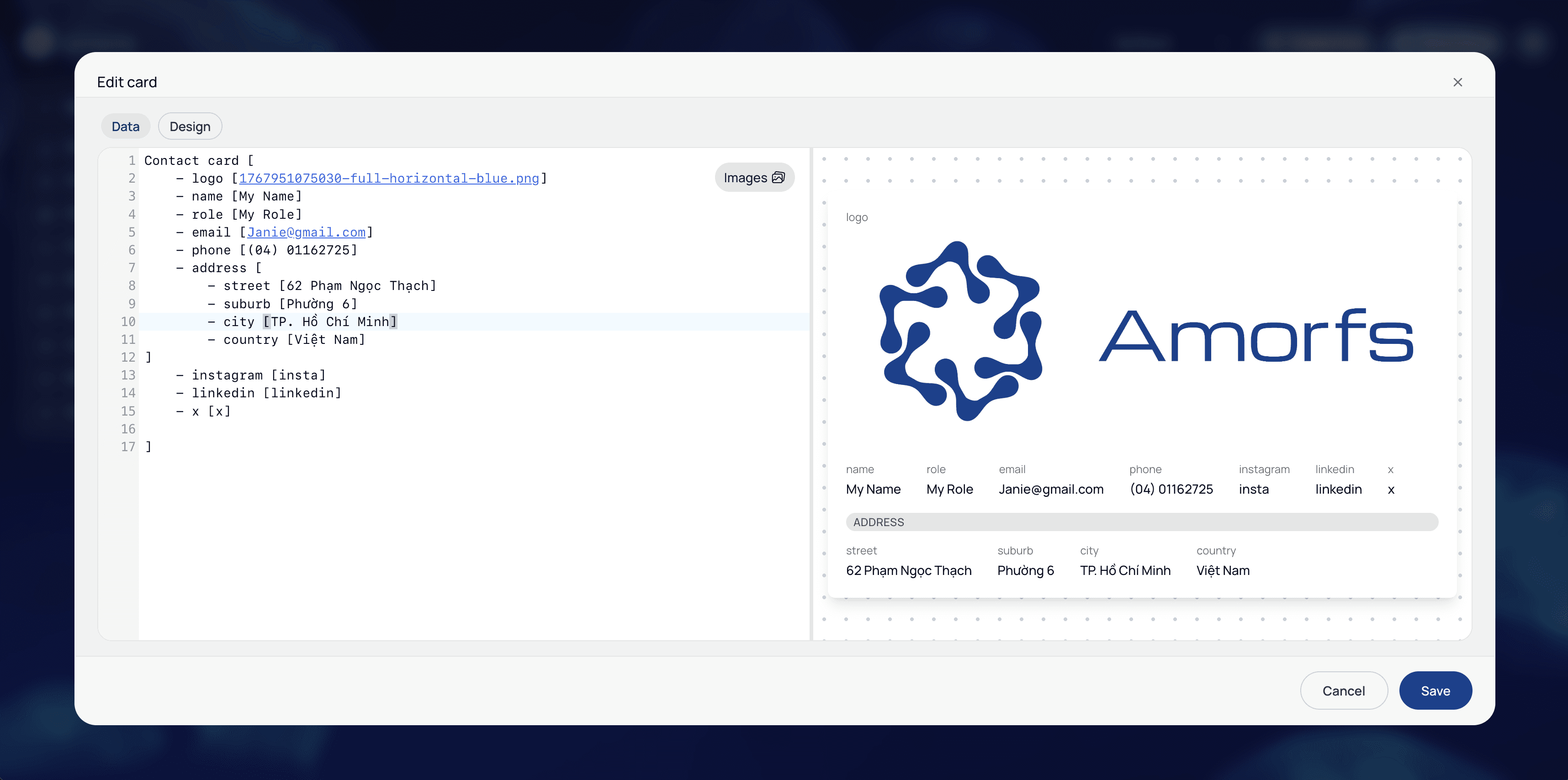
How to Create a New Card in Amorfs Studio
8 Jan 2026
[Guides & How-tos]
How to Create a New Card in Amorfs Studio
8 Jan 2026
[Guides & How-tos]
How to Create a New Card in Amorfs Studio
8 Jan 2026


PRODUCTS
Amorfs Extension
SUPPORT
Don’t want to miss anything?
Get weekly updates on the newest posts, events and tips right in your mailbox.
" height="47.8243px" id="Fi98aqQOS" width="48.001px"/><path d="M 20.148 22.45 L 21.494 15.115 L 13.655 15.115 L 13.655 12.521 C 13.655 8.646 15.176 7.155 19.111 7.155 C 20.333 7.155 21.317 7.185 21.883 7.244 L 21.883 0.596 C 20.81 0.298 18.186 0 16.666 0 C 8.646 0 4.949 3.786 4.949 11.955 L 4.949 15.115 L 0 15.115 L 0 22.45 L 4.949 22.45 L 4.949 38.409 C 6.805 38.869 8.747 39.115 10.746 39.115 C 11.73 39.115 12.701 39.055 13.654 38.94 L 13.654 22.45 L 20.147 22.45 Z" fill="rgb(255, 255, 255)" height="39.11523px" id="o10gvlFLv" transform="translate(13.253 8.885)" width="21.883200000000002px"/></g></svg>)
PRODUCTS
Amorfs Extension
SUPPORT
Don’t want to miss anything?
Get weekly updates on the newest posts, events and tips right in your mailbox.
PRODUCTS
Amorfs Extension
SUPPORT
Don’t want to miss anything?
Get weekly updates on the newest posts, events and tips right in your mailbox.
PRODUCTS
Amorfs Extension
SUPPORT
Don’t want to miss anything?
Get weekly updates on the newest posts, events and tips right in your mailbox.